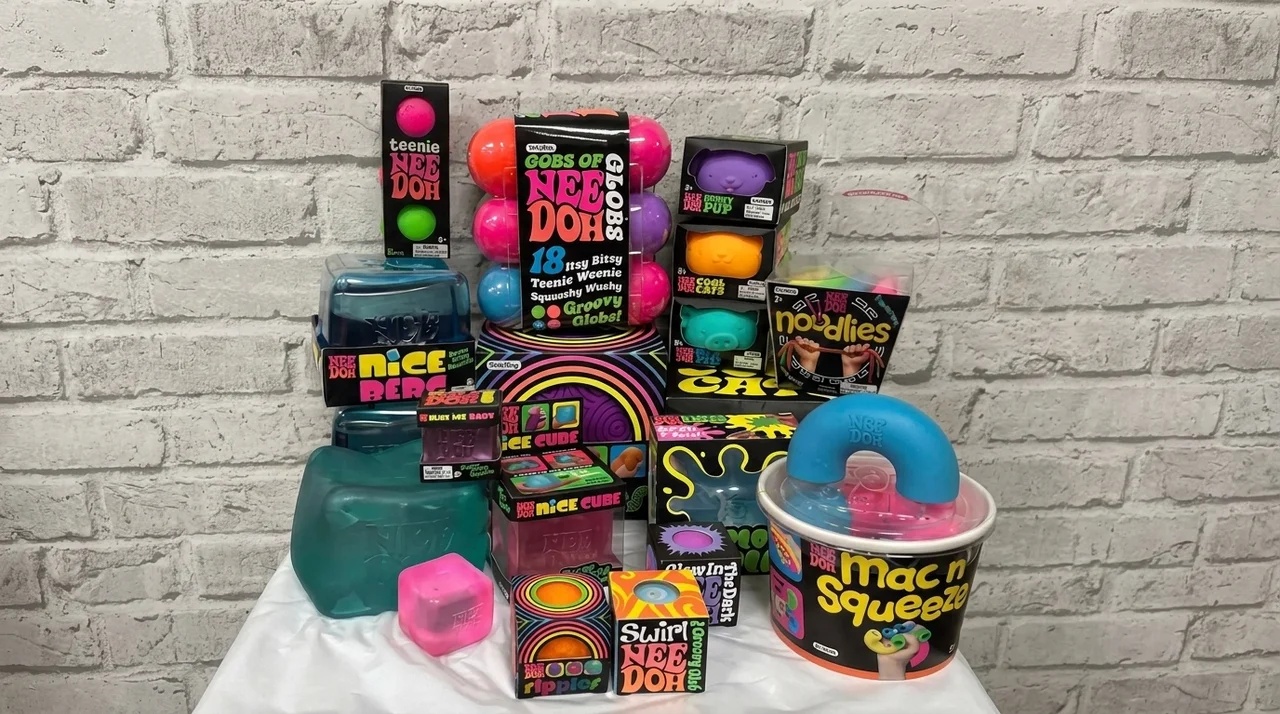
Got a bin of sealed NeeDohs sitting in your closet? You’re probably wondering if it’s worth anything.
Here’s the honest answer: it depends on which NeeDohs you have. This little squishy stress ball went from a $5 impulse buy to one of the strangest resale stories in the toy world this past year. The pricing is messy. Let’s break down what actually happened.
Where NeeDoh Started
NeeDoh has been around since 2017. It’s made by Schylling, a company that’s been making fidget and stress-relief toys for years without much fanfare.
The original NeeDoh is called the Groovy Glob. It’s a squishy, sand-filled ball. You stretch it, and it slowly bounces back to shape.
It was never meant to be a collectible. It was a sensory toy sold near the register, usually for $5 to $8. Bigger versions and multipacks cost more, sometimes up to $30. Nothing about the pricing back then suggested it would ever become a resale item.
That matters, because it explains why the recent price swings are so wild. Most toys that gain real resale value do it slowly. Think vintage LEGO sets or retired Squishmallows. It takes years of production stopping and nostalgia building.
NeeDoh didn’t get that slow build. It exploded almost overnight. The resale market had to scramble to catch up.
What Actually Happened
NeeDoh caught fire on TikTok sometime in the last year. You’ve seen this story before with slime and Orbeez. Short videos of people squeezing and stretching the toy did big numbers.
What made NeeDoh different was how fast those views turned into empty shelves. Schylling reportedly sold an entire year’s worth of inventory in about nine weeks. Stores that had NeeDoh stocked as a cheap impulse buy suddenly had nothing left.
Once shelves went bare, people started hunting online. That’s where prices got strange.
eBay reported a huge jump in NeeDoh searches in its collectibles section. At the peak, searches were up more than 700% in a single month. StockX, a platform best known for sneakers, started tracking NeeDoh prices too. Their numbers showed NeeDoh selling for four to five times retail price during the busiest stretch.
Poshmark and Depop saw listings pop up as well, with prices all over the map depending on the style.
Here’s the catch, though. None of this means every NeeDoh is worth four times retail right now. It means the ceiling moved way up for a narrow slice of styles — the ones that were hardest to find during the shortage. Plenty of other styles just sat close to retail the entire time.
What Actually Drives the Price
A lot of sellers get their expectations wrong here. Let’s get specific about what actually moves the price up or down.
Style matters more than the brand name does
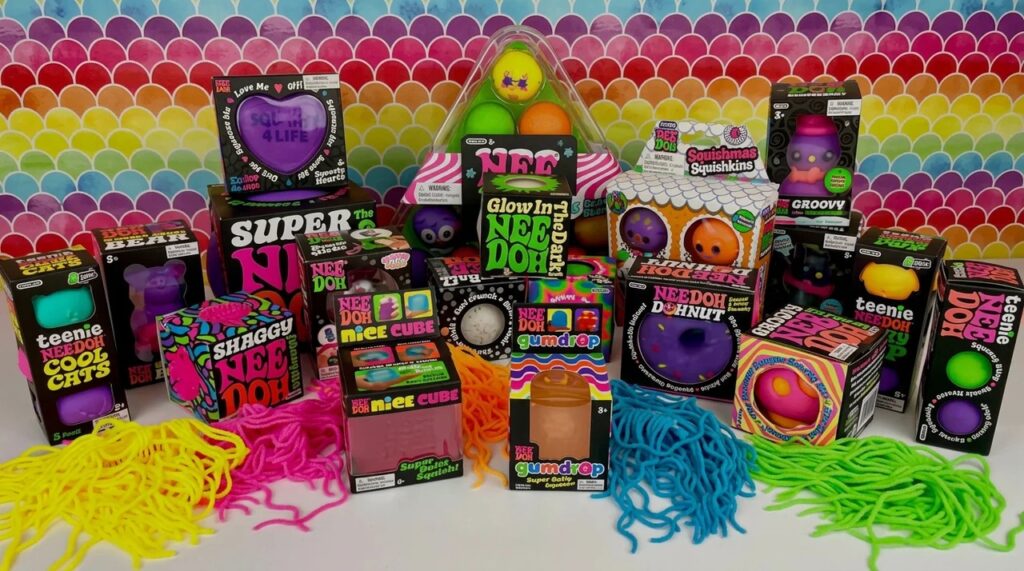
Schylling has put out more than fifty different NeeDoh styles since 2017. Not all of them are equal in resale value.
A current style still sitting on shelves at Target isn’t scarce. Its resale price stays close to what it costs new. A discontinued or limited seasonal style that only ran for a few months is a totally different story. Scarcity does almost all the work here, just like with any collectible.
Sealed versus opened Needohs
One sealed NeeDoh isn’t much of a sale for a buyer to bother with. A matched lot — the same style bought in bulk, or a mixed lot with real variety and no duplicates — is worth more attention.
Here’s an odd feature of the current market. A lot of what’s out there isn’t really a “collection” in the traditional sense. It’s inventory people bought during the panic, sometimes grabbing multiples of the same style because that’s all that was left. That inventory still has value. It just moves differently than a curated collection would.
Authentic vs. Counterfeit Needoh
Once resale prices went up, counterfeits followed fast. Schylling has publicly warned that products from certain overseas sellers are often not authentic.
This matters for sellers too. Buyers are more cautious than they were a year ago. If you bought your NeeDoh from a random third-party seller instead of a store shelf, it’s worth double-checking before you assume it’s real.
Where the Price Guides Fall Short
Search “NeeDoh price guide” and you’ll find sites listing specific dollar amounts for individual styles. Some of these numbers are shocking — hundreds of dollars for a single item.
Take these numbers with a grain of salt.
A lot of these guides are built from scattered listings, not actual sales. They tend to show the highest asking price they can find, not what’s really selling. An asking price on eBay or Poshmark isn’t a sale. Anyone can list a NeeDoh for $500. If it sits there for six months with no buyer, that price tells you nothing.
A better read on real value comes from completed sales, not active listings. The StockX averages are built from real transactions, which makes them more trustworthy. Even then, treat it as a snapshot of a fast-moving market, not a fixed number. A style that had a huge premium during the shortage can lose most of that premium within a few months, once supply catches up. That’s exactly the phase we’re in now.
Where the Market Is Headed
The shortage that caused all this is easing. Schylling has been restocking retailers all year. As shelves fill back up, the scarcity that justified a 400%+ markup starts to fade fast.
This is normal for a viral toy shortage. Squishmallows and Labubu both went through a similar arc. Early scarcity drove wild resale prices. Then supply caught up, hype cooled, and prices came back down to earth.
What does that mean for you? If you’re holding sealed NeeDoh from the peak of the shortage, it’s probably worth more right now than it will be in six months. That’s not a scare tactic. It’s just how these cycles tend to go. Prices set by scarcity are, almost by definition, temporary.
So What Is Your Collection Actually Worth?
Here’s the realistic way to think about it.
If your collection is mostly current-release styles bought recently in normal amounts, it’s probably worth close to retail. Maybe a few dollars more, if anything.
If it includes discontinued styles, seasonal releases, or advent calendars, some individual pieces could be worth a lot more. That’s especially true if the packaging is clean and undamaged.
And if you’ve got a real bulk lot — forty, eighty, a hundred and fifty units from the worst of the shortage — the value isn’t really about any single rare style. It’s about having quantity a buyer can move all at once.
Want to know what a specific style is really worth? Check completed eBay listings for that exact style, not active ones. Weight recent sales more heavily than anything from a few months back. This market moves fast.
How to Sell Your NeeDoh Collection to Us
If you’d rather skip the process of researching every individual style, photographing each one, and listing them separately, there’s a faster path.
Step 1 — Connect. Tell us what you have. For NeeDoh, a rough count and a photo of your collection is enough to get started — you don’t need to identify every style yourself.
Step 2 — Get a quote. We review what you’ve submitted and send back an offer, usually within 48 hours.
Step 3 — Send and get paid. If you accept, we send a prepaid shipping label. Once your collection arrives and we’ve checked it against your submission, you’re paid within 48 hours by check, Venmo, or PayPal.
No listing fees, no photographing dozens of individual pieces yourself, no waiting on buyers one at a time.
We buy sealed NeeDoh of any kind — any style, any quantity, sealed only. If you’re sitting on inventory from the shortage and wondering whether now’s the time to sell, the market conditions described above are exactly why a lot of sellers are asking that question right now.
Most current-release styles are worth close to retail — a few dollars over what they cost new, if anything. Discontinued or seasonal styles can be worth significantly more, but the number depends heavily on the specific style and how recently it sold, not just on the fact that it’s a NeeDoh.
No — the trend has started to reverse. The shortage that drove prices up is easing as Schylling catches up on restocks, and resale premiums tend to shrink as supply normalizes. Values are more likely to be softening than climbing right now.
Some, but far less than a sealed one. Once the packaging is opened, a NeeDoh competes with the broader used sensory-toy market rather than the collector market, and pricing drops accordingly.
Discontinued and limited seasonal styles generally hold the most value, since current-release styles aren’t scarce. Treat any price guide listing specific dollar figures with some skepticism — many are built from unsold asking prices rather than completed sales.
If your collection includes styles bought during the height of the shortage, selling sooner rather than later tends to work in your favor, since resale premiums set by acute scarcity typically fade as supply catches up.