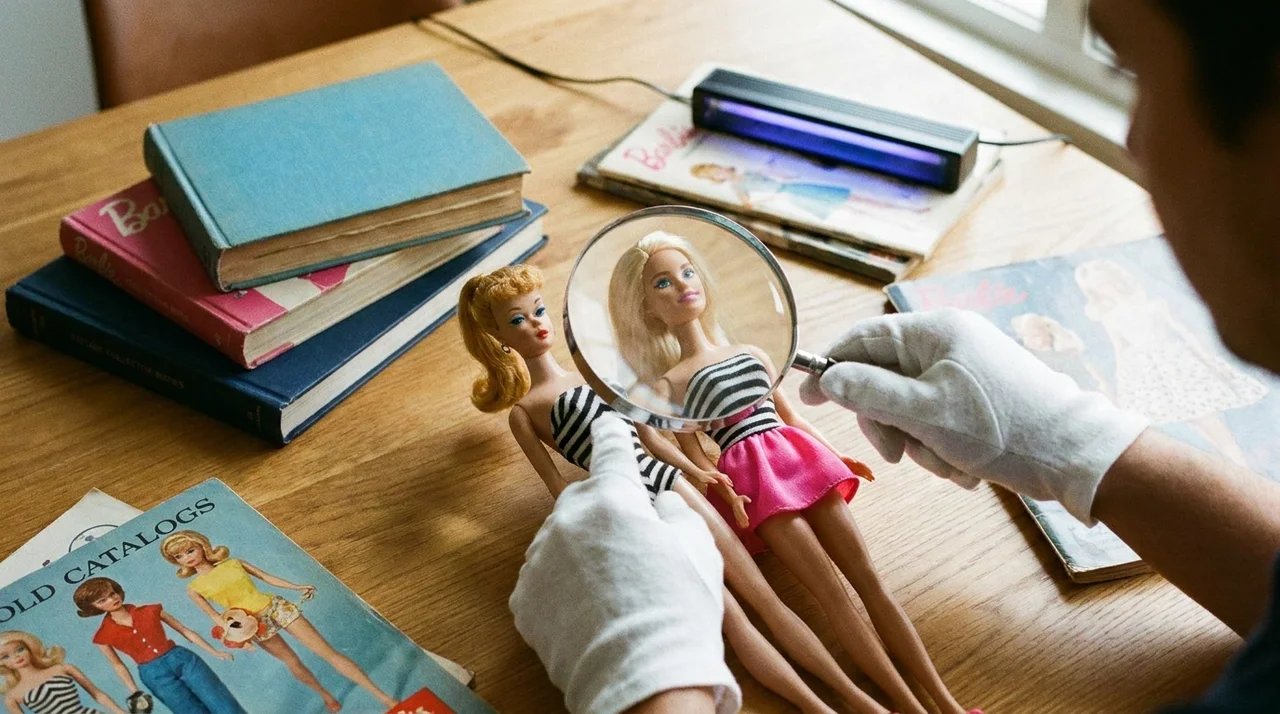
The earliest, most valuable Barbie dolls are also the most likely to have a reproduction or fake passed off as the real thing.
When a specific era or release is worth serious money, someone eventually tries to recreate it.
This guide walks through the checks collectors actually use to tell an original from a copy.
Why This Matters for Sellers, Not Just Buyers
If you’re getting ready to sell a collection, this isn’t only a buyer’s concern. A doll passed down through family, bought secondhand, or picked up years ago from an unknown source could be a reproduction without you realizing it.
This risk is highest for the desirable 1959 to 1966 era.
Catching this before you sell keeps the process smooth and your quote accurate. It also protects your reputation with any buyer. A serious collector or dealer will catch a reproduction quickly, so it’s a far better conversation to have with yourself first.
Check the Body Markings
Authentic vintage Barbies carry specific markings, typically on the right buttock. Look for a copyright date, “Mattel, Inc.,” and a country of manufacture.
The exact format of these markings changed over the decades. That makes them useful both for dating a doll and for spotting inconsistencies.
Here’s the part that trips people up. The copyright date stamped on a doll doesn’t necessarily match her actual manufacture year. Mattel reused certain body molds for years after their original copyright date.
A doll stamped with an early date could have actually been produced much later. Don’t treat the copyright date alone as proof of age. Cross-check it against other details.
Study the Face and Eyebrows
Early Barbies have distinctive facial features that differ noticeably from later vintage dolls and from modern reproductions.
The original 1959 Barbie has a very pale complexion. She also has black-and-white eyes with no blue coloring, and sharply pointed eyebrows shaped like an upside-down V. Later vintage models softened these features considerably, with rounder eyebrows and a wider range of eye colors.
A doll claiming to be an original 1959 release with softer, later-style features is worth serious suspicion.
Check the Hair and Limb Construction
Certain vintage dolls, like the 1960s Twist ‘n Turn Barbie, have specific rooted eyelash details that help confirm authenticity.
Limb construction is another tell. Genuine vintage dolls use specific bendable-limb methods that differ in feel and mechanics from what modern reproductions typically use.
Something about the way a doll’s limbs move or bend feel off compared to reference photos? Take that seriously as one piece of a larger picture.
Examine the Original Tags
Ankle or neck paper tags, when present, can help authenticate dolls made after 1963. Reproductions often skip these tags entirely, or use tags with slightly different fonts, wording, or placement than genuine originals. A doll that should have a tag, based on her claimed release date, but doesn’t have one is worth a closer look.
Check the Packaging Closely
Original vintage boxes tend to be relatively plain cardboard with minimal artwork, by later standards. They also carry specific graphic details and bottom flap labels that changed over time.
Reproductions and modern commemorative reissues sometimes include phrases like “Collector’s Edition.”
Watch also for updated copyright information on the box or an included insert card. These are strong signals of a modern origin, not a genuine vintage piece.
Also check accessory details. Original vintage Barbie shoes, for example, were often marked with “Japan” on the sole. Later or reproduced accessories frequently lack that detail.
No Single Detail Is Enough on Its Own
The most reliable authentication process looks at several factors at once rather than any single detail. Body markings, face mold and features, limb construction, hair details, tags, and packaging all get checked together.
A reproduction might nail one or two of these convincingly while getting the rest wrong. A genuine original should hold up across all of them.
When to Get Expert Help
Professional authentication is worth the cost for anything genuinely valuable, or anything you’re planning to sell as an early, rare piece. Doll repair and authentication services exist specifically for vintage Barbie.
Many have access to reference bodies, parts, and catalog images, which makes subtle differences much easier to spot than photos alone.
Doll collector conventions sometimes bring in these authentication services directly. That’s a convenient way to get an expert opinion if one is happening near you.
What to Do If You Find a Reproduction in Your Collection
Gone through these checks and believe a doll isn’t genuine? Don’t try to sell her as one. Set her aside separately from the rest of your collection. She may still have real value as a well-made reproduction, just not at original-vintage prices.
We only purchase authentic, new-in-box dolls here. Sorting out anything you suspect isn’t original ahead of time keeps your quote accurate.
If most of your collection checks out, check our guide on the rarest and most valuable Barbie dolls next. It’ll help you understand what your genuine pieces might be worth.
Sell Your Authentic Barbie Collection to Us
Once you’ve confirmed what you have is genuine, turning it into cash is simple.
Use our online toy pricer or app to tell us what you have. We’ll review your submission and send back a fair offer, usually within a couple of days.
We charge no listing fees. You won’t photograph dozens of dolls yourself. You won’t wait on buyers one at a time.
People Also Ask…
Check the body markings on the right buttock. Compare the face mold and eyebrow shape against confirmed reference photos for the era she’s claimed to be from. These two checks catch a large share of reproductions quickly.
No. Mattel reused certain body molds for years after their original copyright date. The stamped date doesn’t always match the doll’s true manufacture year. Cross-check it against other details rather than relying on it alone.
Green ear is a discoloration around a vintage doll’s ears from a chemical reaction with certain earring materials. It’s a condition issue on genuine vintage dolls, not a sign of a reproduction. Still, it’s worth knowing about when assessing an older doll.
Yes, though at a fraction of an authentic original’s price. Well-made reproductions have their own smaller market, but they should never be represented or sold as genuine vintage pieces.
For anything you believe is genuinely early or valuable, yes. Professional authentication services have reference materials and expertise. That makes subtle differences far easier to catch than checking on your own from photos.