
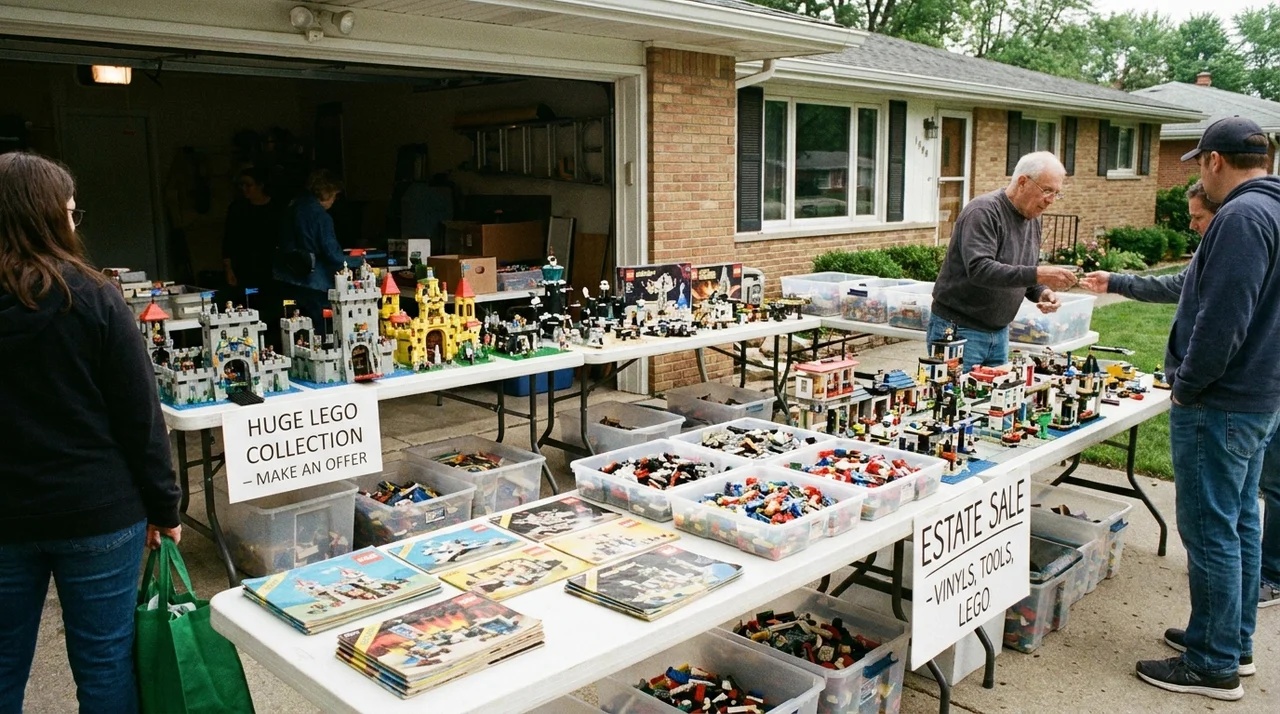
If you have found yourself needing to part with a LEGO collection, whether it is your own after years of collecting, one you inherited from a loved one, or one you are helping to clear out during a downsize, the temptation to turn to an estate sale company can feel strong. It sounds simple. Let the professionals handle it, price everything, and move on. For a lot of household goods, that works fine. For a LEGO collection, it usually costs you money.
The short version: estate sales are built for speed, not for specialty collectibles. LEGO sets can hold serious value on the collector market, and estate sale companies are not set up to find that value, price it correctly, or sell to the right buyers. This article walks through why, and what to do instead.
If you already know your collection deserves a proper evaluation and want to skip the guesswork, you can get a free quote from us here.
What an Estate Sale Actually Is
Estate sales are organized events where the contents of a home are sold off, usually after a passing, a move, or a downsize. Professional estate sale companies handle the logistics: advertising, pricing, tagging, and running the sale itself. Their fee is typically a percentage of total sales, so their incentive is straightforward. Move as much as possible, as quickly as possible.
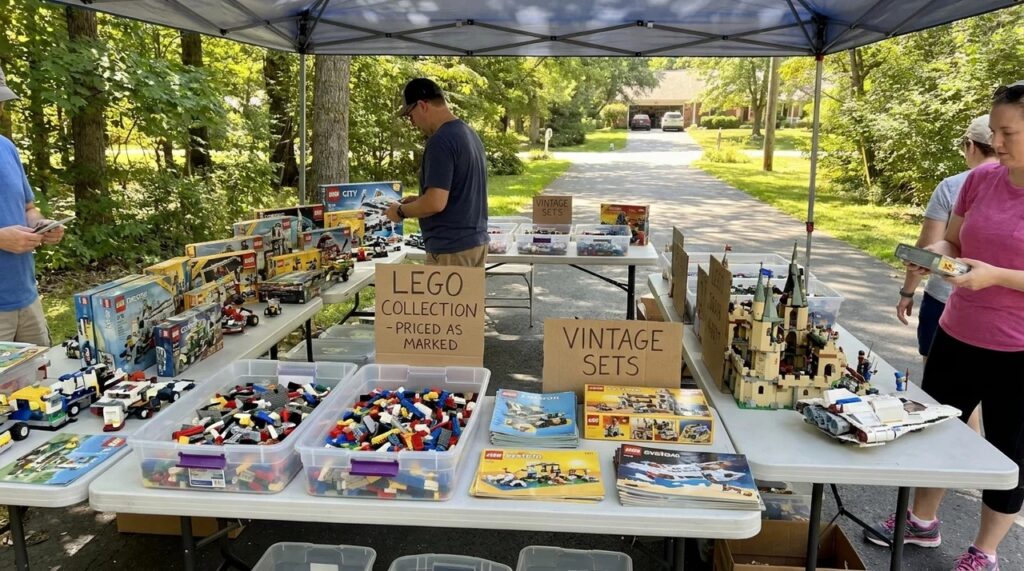
For clearing out furniture, kitchenware, and general household items, that model works. For a LEGO collection that might include sets worth hundreds or thousands of dollars each, the same model works against you.
1. You Will Likely Get 10-40% of What It Is Actually Worth
According to consumer data from the American Society of Estate Liquidators, the average estate sale item sells for only 10 to 40% of its fair market value. That range is fine for a used couch. For a retired UCS LEGO set with a secondary-market value in the thousands, the same math is painful.
Consider a hypothetical: a family finds a sealed 2007 LEGO Modular Cafe Corner (10182) in a closet while clearing out a parent’s home. On the collector market, sealed copies of that set change hands for $2,000 or more. At an estate sale, a company with no specialty knowledge might tag it at $150. It sells in the first hour to whoever spots it first, they resell it themselves at market value the following week, and the family who owned it never sees the difference. That is not an unusual scenario. It is the default outcome for anything specialty going through a general estate sale.
2. Estate Sale Companies Are Not LEGO Specialists
Estate sale companies are generalists by design. They handle everything from silverware to power tools to holiday decorations. That is what they are good at. What they typically cannot do:
- Identify a set by its number and look up current secondary-market value
- Tell a common $30 set apart from a $2,000 retired Modular
- Recognize rare minifigures that can be worth hundreds each on their own
- Distinguish sealed, complete, and incomplete condition tiers, which massively affect price
- Price older or licensed sets that have appreciated well above retail
Even when an estate company means well, they simply do not have the bandwidth to research individual sets during a fast-turn sale. LEGO ends up in a bin priced by the pound or by the box, and the actual value walks out the door with the first collector who shows up.
3. There Is No Vetting of Who Actually Buys It
Estate sales are open to whoever walks in. That means the people most likely to notice a valuable LEGO set are experienced resellers who know exactly what they are looking at, and they are there specifically to profit from mispriced items. That is not a criticism of resellers, they are just doing their job, but it does mean that if your collection has real value, the person walking out with it at estate-sale prices probably knows it, and you didn’t.
For anyone selling on behalf of a family member, there is also a harder-to-quantify factor: those sets meant something to someone. Estate sales don’t sort for that. Selling to a buyer who actually knows and values LEGO tends to feel better on the human side, too.
4. You Have Better Options, Even When You’re in a Hurry
The most common reason people default to an estate sale is time pressure. A house needs to be cleared, a move is scheduled, or there is an estate to settle by a deadline. Estate sales feel like the fastest option. In reality, they are often not.
Selling a whole LEGO collection to a specialty buyer can be just as fast, sometimes faster, and gets you meaningfully closer to fair market value. The process typically looks like this:
- Send a list or photos, no need to catalog every set yourself
- Get a full-collection quote within a couple of business days
- If you accept, use the free shipping labels provided and box the collection up in one trip
- Receive a single payment shortly after your collection arrives
Compared to booking, staging, and running an estate sale, that timeline is often the shorter one, and the collection doesn’t get scattered across strangers at bargain-bin prices in the process.
When an Estate Sale Might Actually Be Fine
To be fair, an estate sale is not always the wrong call. If a LEGO collection is small, mostly consists of common recent sets that have not appreciated, and mixing it in with the rest of the household contents genuinely saves you time and effort, an estate sale can be a reasonable choice. Where it goes wrong is when there are real collector pieces in the mix, and neither you nor the estate company knows to pull them out first.
The safest move, before you decide, is to get a quick sense of what is in the collection. Look for older sets, licensed themes like Star Wars, Harry Potter, or Lord of the Rings, Modular Buildings, LEGO Ideas, and Ultimate Collector Series sets. Our guide to what your LEGO is worth walks through exactly what to look for, and our most valuable LEGO sets guide shows the kind of sets that would be an expensive mistake to leave in an estate-sale bin.
The Better Way to Sell Your LEGO Collection
At Sell Your Toys Now, we have been buying toy and collectible collections for over a decade, and LEGO is one of the things we buy most. We evaluate collections the way a specialty buyer should: set by set, with knowledge of what each is actually worth on the current market, and with a fair offer that reflects that.
Our process is simple:
Step 1 – Connect. Let us know what you have. You can call us at 866.669.8697, email, use our app, or submit photos or a list. The more detail you can share, the more accurate your quote.
Step 2 – Get a quote. Within two business days, our team reviews your collection and sends you an offer.
Step 3 – Send and get paid. If you accept, we send free shipping labels and packing instructions. Once your items arrive and are checked in at our warehouse, you are paid within 48 hours by check, Venmo, or PayPal.
No fees. No open-house strangers. No listings to manage. One evaluation, one offer, one payment.
Frequently Asked Questions
Estate sale items generally sell for 10 to 40% of fair market value, according to industry data. For everyday household items that can be reasonable, but for retired or collector LEGO sets it often means losing hundreds or thousands of dollars per set.
Usually not. Estate sale companies are generalists focused on clearing an entire home quickly. They typically do not have the time, tools, or LEGO-specific expertise to identify sets, look up secondary-market values, or tell rare minifigures apart from common ones.
Selling to a specialty buyer is often just as fast as running an estate sale, sometimes faster. A collection-wide quote typically comes back within two business days, and once it ships, payment usually follows within 48 hours of arrival.
Look for older sets, licensed themes like Star Wars and Harry Potter, LEGO Ideas sets, Modular Buildings, and any Ultimate Collector Series sets. If any of those are in the mix, or if you are simply not sure, get a specialty quote before deciding. A quote costs you nothing and takes the guesswork out of it.
Yes. A large share of the collections we buy come from people sorting through an inherited or estate collection. Send us what you have and we will handle the valuation for you.